Histometrics is a methodological framework developed to examine one of the most persistent problems in the humanities and social sciences: the transformation of concepts as they move across languages, cultures, political systems, and historical periods.
Throughout history, concepts have rarely remained stationary. Ideas travel. Titles migrate. Institutions are translated. And more importantly, philosophical principles are inherited, reinterpreted, contested, and reconstructed by successive generations. As they move, they acquire new meanings while shedding others. Yet despite centuries of scholarship devoted to these transformations, researchers have often lacked a systematic method for measuring the extent and direction of conceptual change.
Histometrics was developed as an attempt to address this intricacy.
Instead of treating conceptual transformation as a (purely) qualitative phenomenon, Histometrics seeks to identify, model, and evaluate the dimensions through which meaning changes over time. The framework combines historical analysis, philology, conceptual history, political theory, translation studies, information geometry, and computational humanities into a unified analytical architecture capable of examining how concepts evolve and where distortions emerge.
The objective is not to replace interpretation with mathematics, nor to reduce complex historical realities to numerical abstractions. The objective is to establish a structured method for identifying what precisely changes when concepts cross linguistic, cultural, and historical boundaries.
Histometrics does not seek to judge concepts, civilizations, ideologies, or historical actors. Its purpose is to identify what changes, how that change occurred, and which dimensions of meaning were preserved, transformed, or lost. It is an analytical architecture for understanding how concepts behave as they move across languages, cultures, institutions, and time.
Conceptual Distortion
Historical scholarship frequently encounters concepts that appear familiar but whose meanings differ substantially across contexts.
Terms such as liberty, sovereignty, democracy, empire, virtue, legitimacy, justice, civilization, and nation often retain their linguistic form while undergoing profound conceptual transformation. The continuity of the word creates an illusion of continuity in meaning.
In reality, however, concepts are rarely transferred intact.
Translation choices, political agendas, cultural assumptions, institutional structures, and historical circumstances all influence how concepts are interpreted and transmitted. As a result, a concept may preserve some aspects of its original meaning while simultaneously losing, expanding, or redefining others.
The challenge facing researchers is not merely determining whether conceptual change occurred. The more difficult question is identifying which aspect of it has changed, how far they shifted, and whether the resulting interpretation remains comparable to its source.
Histometrics was designed to address these questions directly.
Origins of the Framework
The framework originated from a historical investigation into Herodotus’ translation of the Achaemenid royal title XŠĀYAΘIYA XŠĀYAΘIYĀNĀM, commonly rendered as “King of Kings”.
At first glance, the Greek rendering Basileus Basileon appears to be a straightforward translation. Yet closer examination reveals substantial differences between the political, administrative, religious, and universal claims embedded within the original Persian title and those conveyed through its Greek equivalent. Though Herodotus’ translation remains one of the most influential acts of cultural transmission in antiquity, it also illustrates a broader historical phenomenon: concepts are often reshaped by the political and intellectual environments into which they are introduced. Augustus adopted the title Princeps rather than Rex, avoiding a term deeply associated with tyranny in Roman political memory while preserving many of the practical characteristics of monarchical authority. The lexical form changed. The political structure largely remained. Such cases demonstrate how concepts may be strategically reframed without entirely altering the realities they describe.
Therefore, the central question became:
How much of the original concept survived the process?
Answering that question required more than textual comparison. It required a framework capable of modeling concepts themselves.
The result was Histometrics.
What began as an investigation into Persian kingship gradually evolved into a broader methodology applicable to historical narratives, political ideas, institutional concepts, cultural symbols, and contemporary discourse.
Histometrics approaches concepts not as isolated words but as multidimensional structures composed of interacting dimensions. A concept may contain political, religious, military, administrative, ethical, symbolic, or cultural components simultaneously. Different societies emphasize different criteria, and different historical periods activate different aspects of the same concept.
By identifying the constituent dimensions of a concept and evaluating their relative contributions across contexts, Histometrics allows researchers to determine where continuity exists, where divergence occurs, and where comparison becomes analytically unreliable.
The Histometric Computational Pipeline (HCP)
To support this process, Histometrics employs a structured analytical architecture known as the Histometric Computational Pipeline (HCP). The pipeline integrates historical sources, conceptual modeling, dimensional analysis, semantic comparison, and interpretive validation into a coherent workflow.
Instead of allowing computational methods to determine the meaning of concepts autonomously, Histometrics adopts a theory-driven approach in which dimensions are identified through historical evidence, philological analysis, and scholarly interpretation before measurement begins.
Computational procedures serve the historical question rather than replacing it.
The framework seeks to combine methodological rigor with interpretive accountability by ensuring that every measurement remains connected to explicitly stated assumptions and evidentiary foundations.
Applications
Although developed through the study of ancient political language, Histometrics extends far beyond classical history. The framework may be applied wherever concepts transform as they move between contexts.
- Translation studies
- Historical and historiographical analysis
- Political theory
- Intellectual history
- Constitutional development
- Media and discourse analysis
- Strategic communication
- Artificial intelligence and language systems
- Corporate narratives and institutional identity
- Comparative civilization studies
In each case, the central concern remains the same: understanding how concepts retain, lose, or transform meaning as they move through time and across systems.
Computational Humanities
Histometrics belongs to the broader landscape of computational humanities while remaining distinct from most existing approaches.
Traditional computational methods frequently focus on pattern discovery, topic modeling, clustering, sentiment analysis, or semantic similarity. Histometrics addresses a different problem.
Its purpose is not primarily to discover patterns hidden within data, but to establish whether a proposed comparison remains conceptually valid in the first place. The framework emphasizes dimensional integrity, conceptual boundaries, interpretive constraints, and the measurement of conceptual distortion.
In this respect, Histometrics functions not only as an analytical tool but also as a methodological safeguard against false equivalence and uncontrolled interpretation.
A Framework for Conceptual Navigation
Every historical period inherits concepts from earlier periods. Every society receives ideas from other societies. Every translation reconstructs meaning, whether intentionally or unintentionally.
The challenge is not preventing conceptual transformation. Such a transformation is inevitable. The challenge is understanding it.
Histometrics was developed as a framework for navigating these transformations with greater precision, transparency, and methodological discipline.
Its purpose is to provide scholars, researchers, institutions, and decision-makers with a structured method for evaluating conceptual continuity, identifying conceptual distortion, and understanding the historical pathways through which meaning evolves.
Before concepts shape institutions, laws, narratives, and civilizations, they first shape the language through which those realities are understood.
In that sense, words do not merely describe reality.
They Rule Empires.
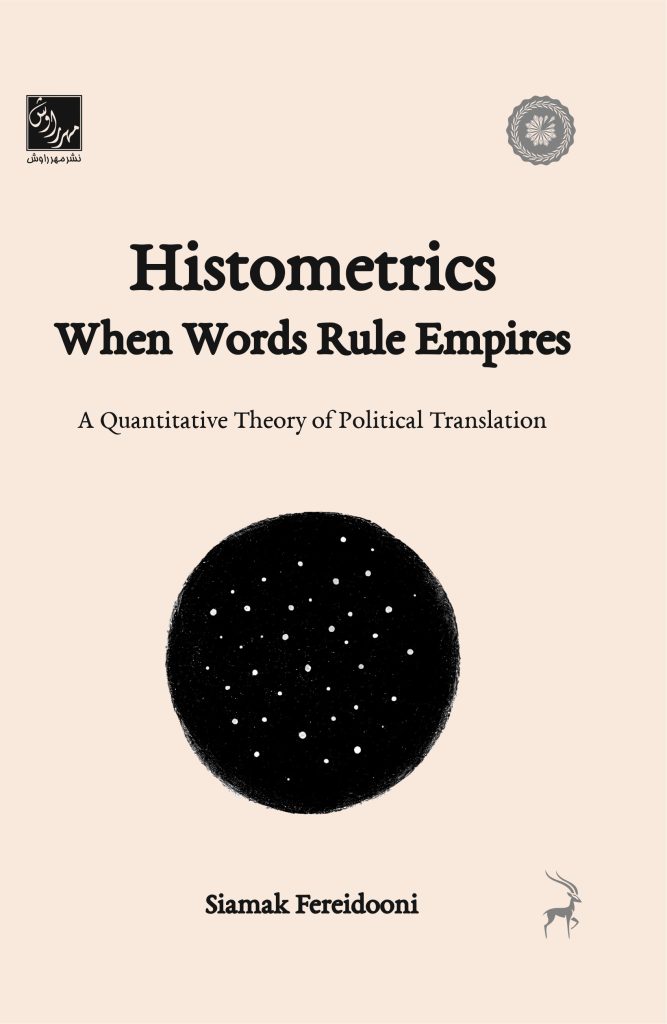
Book details
Histometrics: When Words Rule Empires introduces a framework for measuring how political concepts change as they move across languages, cultures, empires, and historical traditions.
The book begins with a deceptively simple historical question: when Herodotus translated the Achaemenid royal title XŠĀYAΘIYA XŠĀYAΘIYĀNĀM (“King of Kings”) into Greek, was he merely translating words, or was he transforming the concept itself?
Histometrics argues that conceptual transformation can be studied systematically rather than described impressionistically. By combining conceptual history, translation studies, political theory, computational linguistics, and information geometry, the framework models concepts as structured semantic entities whose transformations can be identified and measured.
Using ancient Persian and Greek sources as its primary case study, the book develops a broader methodology for examining how political and cultural ideas survive, evolve, and change as they move through history.
More than a study of translation, Histometrics proposes a new methodological field dedicated to the analysis of conceptual transformation across civilizations and historical periods.
Histometrics: When Words Rule Empires introduces a framework for measuring how political concepts change as they move across languages, cultures, empires, and historical traditions.
The book begins with a focused historical question: how did Herodotus translate the Achaemenid royal title XŠĀYAΘIYA XŠĀYAΘIYĀNĀM (“King of Kings”) into Greek, and what happened to the concept of Persian sovereignty in the process?
The central argument is that translation is not merely a linguistic act but a measurable intervention in political meaning. Concepts do not travel intact. As they cross linguistic and cultural boundaries, some dimensions are preserved, some are compressed, and others disappear altogether. Histometrics provides a method for identifying and measuring these transformations. Drawing upon philology, ancient historiography, translation studies, conceptual history, information geometry, and computational linguistics, the book models political concepts as structured semantic entities occupying a multidimensional space. In its initial formulation, sovereignty is represented through four historically grounded dimensions:
- Religious Sanctification (R)
- Military Role (M)
- Universality (U)
- Governance Authority (G)
These dimensions are derived from primary sources, including Old Persian inscriptions and Greek literary and historiographical texts, and are evaluated against established scholarship in Achaemenid studies, classical history, and political thought.
Using Euclidean distance to measure conceptual displacement and cosine similarity to measure directional alignment, Histometrics demonstrates how Herodotus’ translation reframed the Persian conception of kingship. The result is a replicable framework that identifies which components of a concept are preserved, reduced, amplified, or transformed during transmission.
The implications extend beyond a single title or historical case. Political and cultural concepts migrate across centuries, carrying inherited semantic structures into new intellectual environments. Concepts such as arete, honara, virtue, sovereignty, liberation, legitimacy, and excellence do not emerge in isolation. They persist through chains of translation, reinterpretation, and adaptation. Histometrics seeks to provide a systematic method for tracing those movements.
The philosophical foundation of the project draws upon Ludwig Wittgenstein’s proposition that meaning emerges through use, while engaging broader discussions in conceptual history, discourse analysis, and political theory. Meaning is treated neither as fixed essence nor unrestricted relativism, but as a historically situated structure that can be studied, compared, and measured within explicitly declared limits.
From its initial case study, the book develops a broader methodological architecture that includes:
- The Histometric Computational Pipeline (HCP)
- Lingodynamics, a theory of conceptual preservation and loss in translation
- A constitutional framework for interpretive measurement and evidentiary accountability
- Formal procedures for identifying conceptual distortion, semantic containment, and historical transmission
- A geometric approach to modeling conceptual alignment and displacement
The framework is subsequently applied to Roman imperial titulatures, genealogies of political concepts, translation theory, modern political language, and broader questions concerning the movement of meaning through time. Rather than replacing existing approaches in philology, historiography, translation studies, or computational humanities, Histometrics seeks to provide a common analytical framework through which these traditions can interact. Its objective is to combine the evidentiary rigor of historical scholarship with the formal precision of computational measurement while preserving the interpretive complexity of humanistic inquiry.
While the study begins with a focused investigation of Herodotus and Achaemenid sovereignty, it develops into a broader methodological framework for analyzing how concepts migrate, transform, and accumulate distortion across time.
The book proposes a set of theoretical and computational tools for identifying conceptual change, measuring semantic loss, and evaluating the limits of historical comparison. These tools are applied to cases ranging from Roman imperial titulatures and political vocabulary to modern ideological language and contemporary systems of meaning-making.
Rather than treating concepts as static definitions, Histometrics models them as historically situated structures whose dimensions may be preserved, amplified, or diminished as they move across languages, institutions, and narratives.
The result is a methodological architecture that combines the interpretive strengths of philology and conceptual history with the formal rigor of semantic measurement.
Primary Audiences
- Ancient historians and classicists
- Scholars of Achaemenid and Greek political vocabulary
- Translation theorists and conceptual historians
- Digital humanities and computational linguistics researchers
- Political theorists and historians of political thought
- Philosophers of language and discourse analysts
Secondary Audiences
Information theorists and systems engineers
AI alignment and ethics researchers
Media and communication scholars
- Pierre Briant, From Cyrus to Alexander
- Amélie Kuhrt, The Persian Empire
- Robert Drews, Basileus
- Lawrence Venuti, The Translator’s Invisibility
- Reinhart Koselleck, Futures Past
- Matthew Jockers, Macroanalysis
- Shun-ichi Amari, Information Geometry and Its Applications
- Kutuzov et al., “Diachronic word embeddings and semantic shifts.”
- Sagi, Kaufmann & Clark, “Semantic density analysis.”
- Assael et al., “Restoring and attributing ancient texts using deep neural networks.”
Histometrics integrates philology, political theory, and information geometry into a single measurement architecture.
Part I — The Empirical Demonstration (Sections 1–11)
Sections 1–6 — The Problem of Translating Sovereignty
Introduces the historiographical and philological puzzle: how Herodotus’ translation of the Persian royal title reframed sovereignty. Situates the problem in Achaemenid studies (Briant, Kuhrt), Greek political vocabulary (Drews, Hall), and translation theory (Venuti, Koselleck).
Sections 7–8 — The Histometric Computational Pipeline (HCP)
Defines the four-dimensional sovereignty model (R/M/U/G). Explains how dimensions are derived from primary sources (Old Persian inscriptions, Greek epic, biblical, and Avestan corpora) and validated through secondary scholarship. Introduces vector-space modeling (Manning et al., Deerwester et al., Turney & Pantel, Kutuzov et al.).
Sections 9–11 — The Herodotus Case Study
Constructs semantic vectors for XŠĀYAΘIYA XŠĀYAΘIYĀNĀM and Basileus Basileon. Computes Euclidean and cosine metrics. Demonstrates measurable loss in universality and sacrality. Shows how translation becomes a political act.
Part II — The Foundational Crisis and Reconstruction (Sections 12–18)
Sections 12–16 — Portability and Implications
Tests the framework across Roman titulatures (Imperator vs. Rex), modern political concepts, corporate strategy, AI alignment, and media framing.
Section 17 — The Anti-Thesis
Applies the Five Moves of Doubt to expose the constitutional limits of measurement.
Section 18 — Reconstruction
Rebuilds the framework under Axioms 1–5. Introduces the Adjusted Dimension Contribution (ADC) as the final measurement formula.
Part III — Synthesis and Prospectus (Sections 19–20)
Section 19 — Histometrics as Methodological Compass
Positions Histometrics as a new field for the humanities.
Section 20 — Toward a Field Theory of Semantics
Outlines future research directions.
Histometrics Analysis
If this is what you are looking for, then schedule a meeting and let’s talk